Cybersecurity standard
ISO / IEC 27001 is the world’s most recognized information-security standard — and for good reason. It turns “security best practice” into a certified management system that regulators respect, enterprise customers demand, and cyber insurers reward.
Cyber incidents now unfold in hours, not weeks — one unpatched library or misconfigured API can freeze production lines or trigger multimillion-euro ransom demands. ISO / IEC 27001 tackles that reality head-on: certification hinges on nonstop vulnerability discovery, business-impact triage, and proof of rapid fixes.

ISO 27001
Risk, threat & vulnerability management — one continuous loop
ISO 27001 treats risk assessment, threat intelligence, and vulnerability remediation as a single, closed-loop engine
threat intelligence tells you what could happen
vulnerability management shows where you’re exposed
and risk treatment decides what to fix first
Certification is awarded only when that engine runs continuously and produces hard evidence of control effectiveness
Key clauses driving continuous vulnerability discovery
Sekurno’s targeted, regular penetration tests transform these clauses into hard evidence: we turn threat intelligence into live attack scenarios, stress-test supplier software and services, uncover and verify fixes for critical vulnerabilities, loop exploit data back into the secure development lifecycle, and deliver the auditor-ready documentation that proves control effectiveness
5.7
Threat Intelligence
Organizations must monitor emerging threats and attacker techniques to anticipate potential risks. Threat intelligence informs testing priorities, response strategies, and proactive defense
5.21
Secure development life cycle
Security must be embedded into every phase of development — from design through deployment — with continuous testing to catch flaws early and avoid releasing vulnerable systems
8.8
Managing information security in the ICT supply chain
All third-party components — software, APIs, cloud services — must be vetted for security before use. This includes validation through testing or trusted attestations to ensure they don’t introduce hidden vulnerabilities
8.25
Security testing in development and acceptance
Security controls must be verified before going live. This includes defining structured testing plans (e.g., vulnerability scans, pen tests, code reviews) and ensuring issues are resolved before release
8.29
Management of technical vulnerabilities
You must identify, assess, and remediate system vulnerabilities on an ongoing basis. This includes regular scanning, patching, and validation to prevent exploitation and reduce business risk
One engagement, full-spectrum assurance — helping your ISMS prove that it doesn’t just manage risk on paper, but actively finds and fixes what matters


ISO 27001
What ISO 27001 requires you to verify?
Effective security testing under ISO 27001 requires validating that key controls are functional, enforced, and resistant to real-world threats. Testing should be aligned with both functional (e.g. login security) and non-functional (e.g. resilience, configuration) requirements and must reflect how systems behave under realistic attack conditions.

What include key focus areas?
Security Functions
Validate mechanisms like user authentication, access control, and cryptographic protections to ensure only the right people access the right data, in the right way
Secure Coding
Test application logic and source code for insecure input handling, poor session management, and implementation flaws — ideally starting within the development team
Secure Configurations
Assess operating systems, firewalls, and other infrastructure components for weak defaults, misconfigurations, and unnecessary exposure
Security testing should be performed in an isolated test environment that closely mirrors production — to ensure both reliability and safety. For in-house development, testing starts with engineering teams and must be followed by independent acceptance testing before production deployment
The following activities should be considered
Code Reviews
Identify flaws early in development by scanning for insecure patterns and logic errors
Vulnerability Scanning
Detect known weaknesses in systems and software before attackers do
Penetration Testing
Simulate real-world exploitation to uncover deep issues in design, architecture, and deployment
At Sekurno, we go beyond checking controls — we pressure-test them. Our security testing approach is threat-driven, risk-prioritized, and fully mapped to ISO 27001 expectations. Whether it’s validating crypto implementations, probing for logic flaws, or hardening cloud configurations, we deliver actionable findings and remediation guidance that strengthen your ISMS and satisfy your auditors
How often should you perform penetration testing?
ISO 27001 doesn’t prescribe a fixed frequency for penetration testing — instead, it requires that testing be risk-based, repeatable, and proportionate to the impact of potential vulnerabilities. Auditors suggest testing should be performed:
Annually for core business systems
After major changes to code, infrastructure, or configurations
Upon acquisition of third-party components
Following security incidents or emerging threat reports
More frequently for high-risk, public-facing assets
At Sekurno, we help you align your testing cadence with ISO 27001 requirements and business risk — so you're always audit-ready and ahead of attackers

What Sekurno Tests — Aligned with ISO 27001 Requirements
Testing the controls that certification depends on
Sekurno’s ISO 27001-aligned penetration tests go beyond surface scans. We validate the effectiveness of technical controls that ISO 27001 explicitly requires you to test — from secure development and configuration to vulnerability management and access controls
Mobile Applications
Android & iOS: Sensitive info storage, broken authentication, insecure data transmission, code tampering detection
Web Applications
HTML5, WebAssembly, Progressive Web Apps: Input validation, session management, cross-site scripting prevention, IDORs
Leaked Credentials
API keys, user credentials, database passwords: checks for exposures on the darknet, pastebin sites, hacker forums
Network Pentesting
Private Cloud, Network access controls, server vulnerabilities, endpoint protection, user privilege escalation checks
Cloud Infrastructure
AWS, GCP, Azure: Security policies audit, access controls, encryption at rest, misconfiguration prevention
API Testing
REST, SOAP, GraphQL: Broken authorization, leaked API keys, excessive data exposure, rate limiting checks, endpoint vulnerabilities
Methodology built for ISO 27001 resilience
Our approach combines real-world threat simulation with ISO 27001-aligned testing practices — designed to identify vulnerabilities, validate control effectiveness, and produce audit-ready evidence


Threat Modeling
Map attacker paths to critical systems and data by analyzing assets, user roles, and abuse scenarios — supporting ISO 27001’s risk assessment and threat intelligence requirements.
Manual Testing
Perform hands-on assessments of key controls like authentication, access management, and data protection — going beyond automation to validate implementation effectiveness
Source Code Review
Analyze application logic for flaws in secure coding, input handling, and access control — reinforcing SDLC and technical vulnerability management controls
SAST / DAST Scanning
Automate detection of OWASP Top 10 and ISO-relevant technical vulnerabilities — including injection flaws, insecure storage, and exposed endpoints — while supporting continuous testing in development and acceptance.
Evidence that stands up to scrutiny
Our deliverables don’t just report vulnerabilities — they help you prove control effectiveness, demonstrate due diligence, and satisfy ISO 27001 expectations with confidence
Penetration Report

Сlear documentation of exploited vulnerabilities, attack paths, and recommended fixes — supporting ISO 27001’s requirements for risk treatment and continual improvement
Threat Model Document

Visual breakdown of how threats could impact critical assets — helping demonstrate alignment with threat intelligence and risk assessment expectations
Testing Checklist
A mapped record of tested technical controls — providing traceable proof of control implementation, effectiveness, and audit readiness.
Letter of Attestation
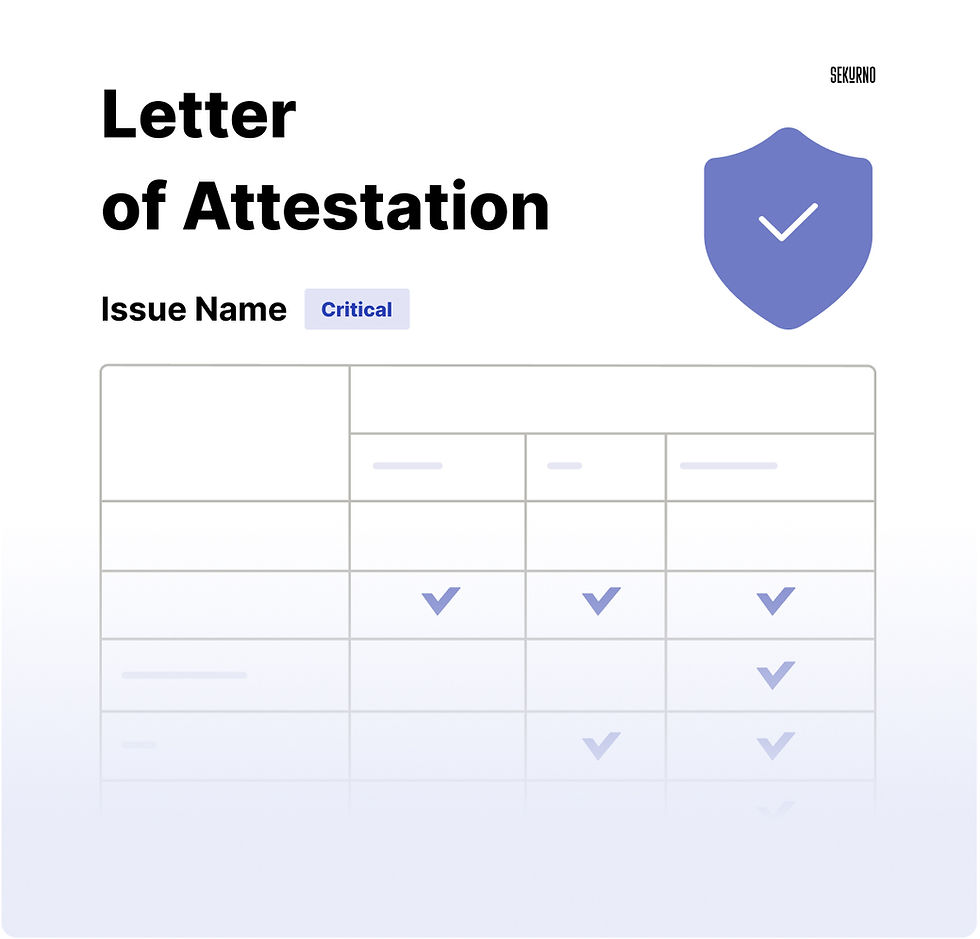
A formal statement confirming all critical and high-risk issues have been remediated and verified, providing independent validation of your system’s security posture
Compliance testing solutions beyond ISO 27001
Our penetration testing services are designed to make your systems truly secure — not just technically compliant. By focusing on real-world threats and infrastructure risks, we help you meet and exceed the expectations of critical frameworks like GDPR, EU MDR, FDA, HIPAA, and SOC 2. Whether you're preparing for regulatory submissions, client due diligence, or certification audits, we ensure your cybersecurity posture delivers lasting protection and regulatory confidence

SOC 2

FDA

EU MDR/IVDR
