Unique Cybersecurity Challenges & Compliance Expectations in Biotech
Biotech companies face distinct security challenges — from safeguarding irreversible genomic data to navigating overlapping regulations like HIPAA, FDA, GDPR, and MDR. This guide walks you through the real risks, architectural decisions, and compliance realities that shape modern biotech operations
Why cybersecurity matters in Biotech
The biotech industry isn’t one-size-fits-all — and neither are its cybersecurity needs. This guide is tailored for platforms operating in key biotech sub-niches, each with its own data types, regulatory exposure, and architectural decisions. This guide helps you:
Understand the security risks unique to biotech
Navigate frameworks like HIPAA, FDA SPDF, MDR/IVDR, GDPR, and ISO 27001
Explore practical strategies like threat modeling, secure SDLC, and cloud-native protections
Learn about pitfalls in GenAI implementation for your healthcare / biotech platform
Backed by engineers, auditors, and compliance experts working directly with biotech platforms, this page compiles the must-knows for founders, security leads, and product teams building in the space.
Who this guide is for?
Biotech is transforming healthcare — from AI-driven diagnostics to personalized medicine and direct-to-consumer testing. But with innovation comes a growing attack surface
Direct-to-Consumer Genetic, Longevity & Health Analytics Platforms
These platforms combine genetic or biomarker testing with data-driven insights around aging, lifestyle, and preventive health. While they serve consumers directly, many also provide dashboards for clinicians or longevity coaches, blurring the line between wellness and clinical oversight.
GDPR/HIPAA overlap, data re-identification risk, long-term storage, consent management, cross-border data transfers
Diagnostics-as-a-Service Platforms
Unlike consumer tools, these platforms provide clinically actionable diagnostics, often supported by AI or advanced analytics. Used by healthcare providers or labs, they typically fall under FDA SPDF, EU MDR/IVDR, and CLIA regulations — requiring validated workflows, documentation, and lifecycle security.
Third-party access, consent enforcement, data anonymization, HIPAA/GDPR compliance, auditability, research ethics
Data Marketplaces & Clinical Trial Recruitment Platforms
This includes genomic data marketplaces, research data exchanges, and clinical trial recruitment tools — platforms that manage sensitive patient or genomic data across organizations. Whether enabling data sharing or matching patients with studies, these tools must enforce strict access controls, consent tracking, and vendor risk oversight.
Third-party access, consent enforcement, data anonymization, HIPAA/GDPR compliance, auditability
Data Responsibility
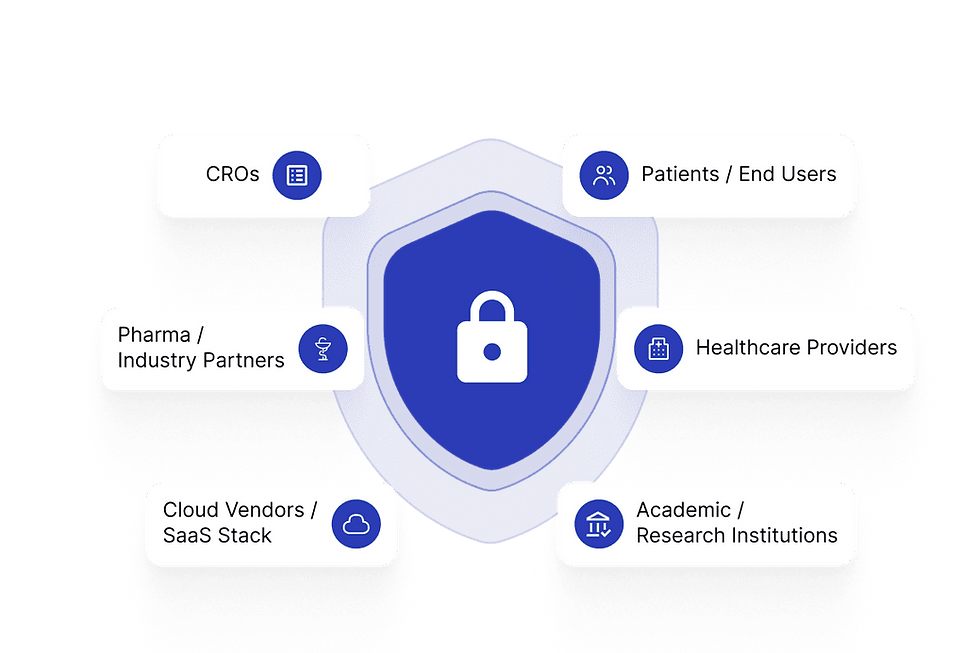
Biotech platforms operate at the intersection of sensitive data and multi-stakeholder demands. Patients expect privacy and control. Pharma partners and CROs require auditability, compliance alignment, and trustworthy data governance.
Each stakeholder introduces unique expectations, regulatory pressures, and security risks — all of which shape how data is managed, secured, and audited.
This guide distills the core considerations for founders, security leads, and product teams building in biotech — informed by hands-on experience from engineers, auditors, and compliance experts working directly with platforms in the field.
How Sekurno can help?

Penetration Testing
A hands-on security assessment simulating real-world attacks on your infrastructure, application, or cloud setup. It’s also a common prerequisite for partnerships with healthcare providers and pharma companies. Explore how security testing uncovers biotech risks.
Explore how security testing uncovers biotech risks

Threat Model Document
A proactive exercise used to identify how your systems might be attacked, which data flows are most exposed, and where controls should be placed. Threat modeling helps you focus security efforts on what matters most — based on how your product actually works.
In regulated environments, threat modeling is often used as documentation to demonstrate that you’ve identified your security and safety risks — a critical part of pre-market submissions, audit trails, and CE marking processes.
See how to map and prevent threats in biotech platforms

GenAI Architecture
Integrating GenAI into biotech platforms brings powerful opportunities — and serious risks. Most teams underestimate the security and compliance implications of embedding health data (or even PHI) into vector databases, prompts, or third-party models.
Without proper data sanitization secure-by-design architecture, even “just metadata” can expose you to HIPAA violations and prompt leakage.
AWS or GCP won’t make you compliant by default. You need a signed BAA, proper access controls, and to ensure sensitive data never reaches the model unprotected.
How to design GenAI systems securely in healthcare
Compliance Landscape
This section isn’t just a list of regulations — it’s a map.
We explain what each standard is, when you become subject to it, what concepts you need to understand (like PHI or SaMD), and where to go to explore it further.

HIPAA – U.S. Health Data Privacy Law
HIPAA applies when your platform handles Protected Health Information (PHI) in the context of U.S. healthcare — typically when working with labs, clinics, hospitals, or insurers, collectively known as Covered Entities. Many assume all health data is PHI. It’s not. PHI is health-related data that’s identifiable and processed within a covered entity context.
If your platform is a covered entity or processes data for one, HIPAA likely applies.
HI = Health Info + Identifier + Covered Entity Context

FDA – U.S. Regulator for Medical and Diagnostic Products
The FDA regulates platforms that offer tools to diagnose, treat, or manage health conditions — whether through software, lab processes, or expert-reviewed reports.
For example, a company that sells DNA testing kits and provides general wellness insights (e.g., nutrition or sleep advice) is not subject to FDA.
But if the same company starts using that data to diagnose disease or guide treatment decisions, they may require FDA clearance.
If your reports support clinical decision-making, you’re likely offering a regulated diagnostic product.
Trigger = Clinical claim + U.S. market + diagnostic or treatment intent
What the FDA Expects from Cybersecurity: SPDF Guidance
When regulation applies, the FDA expects cybersecurity to be integrated into your development lifecycle. The Secure Product Development Framework (SPDF) outlines:
-
Threat modeling
-
Software Bill of Materials (SBOM)
-
Vulnerability handling & patching
-
Post-market monitoring

EU MDR & IVDR – Cybersecurity for Medical and Diagnostic Devices in Europe
The Medical Device Regulation (MDR) and In Vitro Diagnostic Regulation (IVDR) are the European counterparts to FDA oversight — applying to platforms that offer medical or diagnostic functionality in the EU.
If your platform analyzes biological samples or supports clinical decisions for users in Europe, you may fall under MDR or IVDR — even if it’s software-only.
Key Concept:
These regulations now classify many digital diagnostics, genetic testing services, and other non-physical tools as regulated medical or in-vitro diagnostic devices.
Trigger = EU market + medical/diagnostic functionality or data reporting

ISO 27001 & SOC 2 – Proving Your Security Posture
ISO 27001 and SOC 2 are leading security frameworks used by biotech companies to demonstrate mature, auditable security practices — especially when handling sensitive personal, health, or genomic data.
While neither is mandatory, both are often requested by enterprise clients, partners, or investors as a sign of trust and operational maturity.
ISO 27001 is a certifiable international standard focused on building a formal Information Security Management System (ISMS).
SOC 2 is a US-based attestation report that evaluates how well your security controls meet specific Trust Principles like Security and Availability.
What compliance actually demands in practice
Most regulations — HIPAA, ISO 27001, SOC 2, FDA, MDR — don’t prescribe exact tools. But when you break them down, they all point to the same thing: your platform should be able to withstand real threats.
Whether driven by compliance, client expectations, or investor due diligence, biotech companies are expected to adopt a core set of security practices — not just to pass audits, but to genuinely reduce risk.
Below are the disciplines that make that possible.